Celtic Knots
Celtic knots are a form of sacred geometry that symbolize the interconnectedness of all things. They represent
the eternal web and the continuous cycling of existence. Because they are universal, essential to human experience, knot
motifs are found throughout the world, from Europe to Tibet to the tribal cultures of Africa.
We are often asked what each knot signifies. If you meditate with a particular knot, you may get some insights. What a
knot means to you is what is most important. To assist you, however, we offer the following overviews of our major
knots, based on our personal studies of sacred geometry.
|
Aria Square Round Pendant |
Aria Knot:
This knot is formed from the intersecting lines of three circles. The three petals represent the connections between
three related aspects of life, such as body, mind and spirit, or in ancient Celtic goddess lore: maiden, mother, and
crone. The symmetrical lines suggest harmonious and balanced flow between the three aspects. |
|
 | Aegis Knot:
This is one of Helen's most artistic and original knots. On one look it's a flower. Look again and it's a dancing image,
and look again and it’s a shield. The movement in the lines is joyful and playful, aesthetic and expanding.
|
|
 | Bridget Prague:
Imagine over 2300 years ago some gifted artisan cast this design into bronze jewelry. The motif spread through several
regions of what is now Italy, Hungary and Germany. The design resembles the curl of a plant's stem or root, or the path
of a river. No one can be certain as to what it means, but to us, it seems to symbolize the fertility and fecundity of
the earth itself. |
|
 | Celtic
Corners:
The square is a shape not commonly found in nature. The knot work represents structure and foundation. A square can
also deal with communication. There are five points in a square – the four corners and the center (since the knot
pattern is connected in the center by diagonal lines). |
|
 | Celtic Key:
This geometric design shows part of a circle or arc triangulating toward a center. It is a "key" design. It
represents directed energy from the outside, that is focused toward the core or central place. From another
perspective, it illustrates gathering information and getting to the very essence or depth, from which greater insight
can be had. |
|
 | Ceres Knot:
This beautiful knot has a unique balance and graceful ease in its lines. From one angle, it looks like a human standing
in peace with arms joined in balance. From another angle, it suggests a sublime sacred geometry, the lumiscape, or
infinity sign, the building blocks of life, coming into focus and direction. |
|
 | Donegal:
Gold in ancient times was symbolic of the sun while the receptive moon was often associated with silver. This motif,
with its alternating gold and silver knot motif is bold and distinct. It basically symbolizes the weaving together of
two paths, or the harmony of solar, masculine energies with the feminine, moon energies. |
|
 | Flores:
In spring, 2006, Helen visited Angkor Watt, in Cambodia. Though the motif of a vine and leaves is completely universal,
the motif was inspired by designs from ancient Khmer culture. To us, it symbolizes the verdant fertility of the plant
world. |
|
 | Heart Knot:
This knot speaks clearly to all. In the shape of a heart, it’s the symbol of human love, with the interconnecting lines
suggesting the eternality of life and the unity with others we feel in any true act of love. |
|
 | Helios Border
Knot:
This knot is one of Helen's favorites for bordering or surrounding a piece of jewelry. If you trace the path of the
line, you find that it flows in a gentle sine wave, and then suddenly turns back, zig-zags, and then continues on its
way. This pattern suggests a way of moving through life. There are cycles of flowing gracefully ahead, and there are
cycles of looking back and reviewing, and perhaps re-experiencing from a new viewpoint, integrating, or at least slowing
down to really behold, and smell, the flowers. |
|
 | Interlace Knot:
The Interlace knot may be the most intriguing of Helen's knots. It combines linked heart shapes, straight lines and 90
degree angles, with the four hearts pointing to the center, and forming a cross. The circular shape symbolizes the
balancing of energies from the four directions into one’s relationships with oneself and the universe.
|
|
 | Kells Knot:
The Kells knot represents building structured relationships. With the knot positioned as a diamond, the upward pointing
vertical line represents spirit, and the downward pointing line represents matter or earth. The square shape is good for
building solid foundation. |
|
 | Konya:
The oval represents creativity and fertility, while the triangle represents the intense focus of energy toward a goal.
In combination, this design, which is like an atom, represents dynamic creativity coming into power and focus.
|
|
 | Laura:
Two people or paths of energy, working in a circle, gather their forces from the outside, where they are deeply
connected to their environment, and focus it toward a more interior goal. This design shows these two arcs sweeping
into each other, creating a harmonious centering and blending together. |
|
 | Leaf:
This knot, though small, is fairly complex. On the one hand, this knot has an oval shape, symbolizing creativity and
fertility. Yet, the end of the design oval is pointed, which represents specific direction and intent. Within the
design are two triangular knots which also indicate a strong direction. From a completely different perspective, the
motif resembles a leaf. |
|
 | Maya Knot:
This knot resembles a balanced heart on the inside and a "pointing heart" on the outside. Fixed on one end, and fluid on
the other, the lines of energy move out to the tip, but not before crossing and mixing feminine and masculine.
|
|
 | Petra:
This design, which shows intersecting triangular points opposing each other in balance, is symbolic of dynamic
creativity which is focused into a greater holistic, harmonious pattern. |
|
 | Ravena:
The Ravena motif is inspired from archeological evidence remaining from Celtic tribes that lived in in Central Europe,
2400 years ago. It shows the spiral, which has always symbolized growth, gathering into a circle. To us, this design
represents creative action. We see similar lines in the root of a plant, the eddies of a river, or any circle of
communities amassing energy to make something new. |
|
 | Renee:
This knot is about intense focus through creativity, as shown by the triangular pattern. Yet this triangular focus is
integrated into personal structures, symbolized by the rectangle. Another way of considering this is that it is a knot
that represents going from one project or idea to the next – each distinct yet woven into a holistic, cohesive
pattern. |
|
 | Scroll:
This rectangular knot symbolizes the development of personal foundations and structures that are complex yet functional.
Within the straight edges, the triangular motifs and central, curvy design suggests the integration of complex and
dynamic movement into a harmonious flowing whole. |
|
 | Shannon
Knot:
Symbolic of continuity over time, this knot can be extended to any length. In this knot, the energy moves quickly and
endlessly over the pattern, always the same from any angle. |
|
 | Sita Knot:
The Sita knot symbolizes the interconnectedness of aspects of life which come in cycles of fours, such as the four
seasons, the four stages of life (youth, adolescence, maturity, old age), and the four phases of the moon. The outermost
lines form a near-circle, suggesting growth while weaving new experiences and relationships into understanding.
|
|
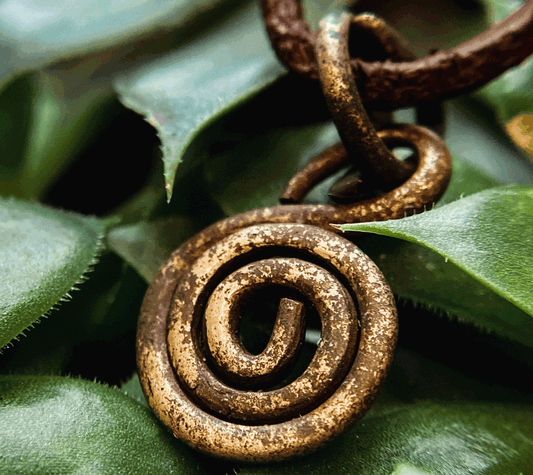
 | Spiral
Knot:
Spiral knots are found in all cultures across time. Moving outward from the center represents the flow of the
mysterious forces of creation into the manifested world. Moving from the outside into the center represents the inward
path of growth and the exploration and unraveling of the mysteries of self and life. |
|
 | Tara:
The origin of this design is 3rd to 5th century BC France. The Celts wore jewelry for adornment and also as a talisman,
a power object, an anchor for remembrance, a way of connecting to the greater cosmos. This mysterious motif is clearly
inspired by nature. Perhaps in it, you see a flame that rises from the earth, a river stretching across marshes, or a
fern tip. |
|
 | Tikal/Rope:
This design shows two gold pathways that weave into each other evenly and harmoniously. The design simply represents
two paths, two people or even two energies that are able to work together to creating a common circle. Since they
connect, the knot also represents the eternal connection of the two separate ways. |
|
 | Trinity Knot:
The trinity knot "tri-unes," representing three aspects from one unity. With the accent on the downward vector, this
knot shows a movement of the male and female principals coming up from earth, from which our bodies are created. This
knot also suggests a flow of creative energy from below our feet into the world of time and matter.
|
|
Copyright © 1998-2010 Reflective Images, Inc. ® All rights reserved.